Monday, July 29, 2013

Warm Bodies by Isaac Marion

Title: Warm Bodies
Author: Isaac Marion
Type: Young Adult Novel
Genre: Fiction
Series: Sort of. It has a mini Prequel
Pages: 241
Copyright: 2011
Publisher: Emily Bestler Books/ATRIA
Rating: 4 out of 5


Summary: from Goodread
R is a young man with an existential crisis--he is a zombie. He shuffles through an America destroyed by war, social collapse, and the mindless hunger of his undead comrades, but he craves something more than blood and brains. He can speak just a few grunted syllables, but his inner life is deep, full of wonder and longing. He has no memories, noidentity, and no pulse, but he has dreams.After experiencing a teenage boy's memories while consuming his brain, R makes an unexpected choice that begins a tense, awkward, and stragely sweet relationship with the victim's human girlfriend. Julie is a blast of color in the otherwise dreary and gray landscape that surrounds R. His decision to protect her will transform not only R, but his fellow Dead, and perhaps their whole lifeless world.

Scary, funny, and surprisingly poignant, Warm Bodies is about being alive, being dead, and the blurry line in between.
 

Feelings:
I did see the movie before I read the book but the movie didn't take anything away from reading the book. So if you enjoyed the movie you will enjoy the book as well. There were some big difference between the book and the movie. Some of the issues I had with the movie distance and time, long time to get there verse short time the last time, were not issues in the book and were explained. The movie had some wonderful parallels that were not as defined in the book. The movie also seemed to play on Romeo and Juliet a little more than a felt like the book did. I thought that it worked well in the movie and what was in the book was fun as well. I liked both the book and the movie but because they were different I didn't really have a problem knowing and anticipating what was coming in the same way I might have if the movie followed the book closer.

Warm Bodies is many different things at once. It is a story about love and acceptance. It is a story about the consequences of our current lifestyle and our inability to connect with others. This is a very simple book in many ways but there are things hidden in here that can be viewed as warnings. This book has a message and that message is if humans disconnect from each other we will become zombies.
No one I know has any specific memories. Just a vague, vestigial knowledge of a world long gone. Faint impressions of past lives that linger like phantom limbs. We recognize civilization--buildings, cars, a general overview--but we have no personal role in it. No history. We are just here. We do what we do, time passes, and no one asks questions. But like I've said, it's not so bad. We may appear mindless, but we aren't. The rusty cogs of cogency still spin, just geared down and down till the outer motion is barely visible. We grunt and groan, we shrug and nod, and sometimes a few words slip out. It's not that different from before. (p.4)
R is a zombie and for a zombie he is pretty intelligent however, he cannot express these feelings. There is lots of internal dialogue in the book from R's point of view it is funny and entertaining the thoughts he has. I enjoyed this internal monologue but I can also see how it might be annoying are boring to some people.
I don't know why we have to kill people. I don't know what chewing through a man's neck accomplishes. I steal what he has to replace what I lack. He disappears, and I stay. It's simple but senseless, arbitrary laws from some lunatic legislator in the sky. But following those laws keeps me walking, so I follow them to the letter. (p.8)
R does a lot of questioning but it is really when he meets Julie that he begins to think about being human in a different way. Maybe it is because he eats a brain that just isn't willing to leave him alone or maybe it really is a change in him created by the connection he feels with Julie. Whatever the case, this is a fun, funny, at times sad  book about humanity.

I would recommend this book to most people. It is not your typical gory zombie story and I really liked that. Read it or watch the movie they are both great.

Monday, July 22, 2013

Every Day by David Levithan

Title: Every Day
Author: David Levithan
Type: Young Adult Novel
Genre: Fantasy
Series: No
Pages: 324
Copyright: 2012
Publisher: Alfred A. Knopf
Rating: 3 out of 5


Summary: From Goodreads
Every day a different body. Every day a different life. Every day in love with the same girl.

There’s never any warning about where it will be or who it will be. A has made peace with that, even established guidelines by which to live: Never get too attached. Avoid being noticed. Do not interfere.

It’s all fine until the morning that A wakes up in the body of Justin and meets Justin’s girlfriend, Rhiannon. From that moment, the rules by which A has been living no longer apply. Because finally A has found someone he wants to be with—day in, day out, day after day.


Feelings: 

I had great hopes for this book. Maybe it being in first person should have been a tip off that it wasn't going to be as good as I hoped. There seemed to be great potential for the story, and I enjoyed most of it. My problem was that I ended up having more questions at the end of the book than were answered. This is never exactly a good thing. For instance if A trades bodies everyday what happens to the person whose body he inhabits? Are they just pushed aside for a day? That is what the book makes it seem like. How did A come to be? Does he have parents? Did he have a body at one point and lost it somehow? I had a lot more questions than this as well to list them all will not change that I have them and the book didn't answer them.

The writing was enjoyable to read and the story itself was unique and led to questions of sexuality and the fluidity of love. Do we love beyond our sex, male or female? A doesn't just inhabit males but also females the only thing they have in common is that they are the same age as he is. Other than age there isn't much consistency  A can wake up a girl or boy, of any race, or weight. This is difficult for A who is in love with a girl who has a hard time coming to terms with the fact that A is ever changing. This book can be viewed from the lens of GLBT, and it does a good job presenting a non judgmental view of this.
It's hard being in the body of someone you don't like, because you still have to respect it. I've harmed people's lives in the past, and I've found that every time I slip up, it haunts me. So I try to be careful. (p.2)
This is how A starts the day in Justin's body. However, he does not long stay respectful but begins to act of his own will rather than thinking what the person whose body he is inhabiting would want.
There's a notebook on his desk. Remember that you love Rhiannon, I write in his handwriting. I doubt he'll remember writing it. (p. 27).
Rhiannon is the start A not living cautiously and making mistakes. This is what makes the story good. I believe that A would decide to start living differently because of a connection that might be maintained with Rhiannon that he didn't have before.  He wants to feel connected and remembered. Things he didn't think he wants he begins to want.

If the book had answered a few of the big questions I think maybe I would have liked it more. As it stands I think if you are willing to look beyond the questions this is a unique fun book.


Monday, July 15, 2013

Ship Breaker by Paolo Bacigalupi

Title: Ship Breaker 
Author: Paolo Bacigalupi 
Type: Young Adult Novel 
Genre: Science Fiction 
Series: Companion to The Drowned Cities 
Pages: 323 
Copyright: 2010 
Publisher: Little Brown and Company 
Rating: 3 out of 5


Summary: from Good Reads.

A gritty, high-stakes adventure set in a futuristic world where oil is scarce, but loyalty is scarcer.

In America's Gulf Coast region, grounded oil tankers are being broken down for parts by crews of young people. Nailer, a teenage boy, works the light crew, scavenging for copper wiring just to make quota-and hopefully live to see another day. But when, by luck or by chance, he discovers an exquisite clipper ship beached during a recent hurricane, Nailer faces the most important decision of his life: Strip the ship for all it's worth or rescue its lone survivor, a beautiful and wealthy girl who could lead him to a better life....

In this powerful novel, Paolo Bacigalupi delivers a thrilling, fast-paced adventure set in a vivid and raw, uncertain future.


Feelings: 

This book felt like it was trying to make a point about climate change. The oceans have risen and many cities are now underwater. Oil is scarce and the jungle has taken over the world that we know. The rich sail in clippers with para-sails that get shot up into the jet stream.

Nailer dreams about what it would have been like if he had not been born where he was. What might have been if Richard Lopez was not his father. What would have happened if he hadn't been able to get out of the oil. An event that changes the way he thinks. Could he leave someone to die like Sloth was going to do to him? But family is blood and Nailer doesn't leave his father to die even when a city killer sweeps the beach of all their houses and Richard is to high and drunk to wake up.
"My dad!" He waved back at his own shack, a shadow still miraculously upright. "He won't wake up!" Pima's mother stared through the blackness and rain towards the shack. Her lips pursed. "Hell. All right." She waved at Pima. "You take him up." (p. 65-66).
After the storm is over Nailer realizes that he can't just let someone die when he could help them even when he doesn't know that person.
What was wrong with him? Nailer wanted to punch a wall. Why couldn't he just be smart? Why couldn't he just crew up and cut the girl and take the scavenge? Nailer could almost hear his father laughing at him. Mocking him for his stupidity. But as Nailer stared into the drowned girls pleading eyes, they might as well have been his own. (p. 99-100)
Knowing what it felt like to be left to die Nailer can't do that to someone else. The act of saving the girl, Nita, changes how he views the world. It also leads to Nailer wondering about family and blood and what it really means.

This book is full of character development. It also stresses the importance of environmental consciousness in a new and different way. Placing the story on the gulf coast after there are no longer big cities because of the number of hurricanes and storms that hit the coast, creates a kind of awareness of what might happen without it seeming to be a dooms day environmental book.

I would recommend this book to readers that enjoy a good story with adventure, chase, and fighting.

Monday, July 8, 2013

Becoming Finola by Suzanne Strempek Shea

Title: Becoming Finola
Author: Suzanne Strempek Shea
Type: Novel
Genre: Fiction
Series: No
Copyright: 2004
Publisher: Washington Square Press
Rating: 5 out of 5

Summary: from Good Reads

In the latest novel from the award-winning author of Around Again, an American takes an unexpected trip to Ireland and finds the woman she was meant to become. Newly unemployed, Sophie White has nothing better to do when her recently widowed best friend, Gina, invites her along on a much-needed, postcrisis getaway. When, after only one day in Ireland, Gina decides she should do her grieving back at home, she urges Sophie to remain and make the most of the summer in Booley, the tiny seaside village that was their destination.

A job offer accepted on a whim lands her in the village's craft shop, and in the position once held by Finola O'Flynn, a woman who'd swiftly left town a few years before. Sophie takes on Finola's job of creating beaded bracelets, but also takes over Finola's abandoned home, then Finola's left-behind wardrobe, and finally, after her own episode of lost love, Finola's discarded man, charismatic shop owner Liam. But could Sophie -- or anyone -- ever take over the legendary place that her predecessor still holds in the hearts of Booley?

Friend, confidante, and guru to all -- literally a lifesaver to some -- even in her absence Finola continues to captivate. Her myth manages to reenergize Sophie, who passes along the gift through bracelets she infuses with invented "powers" that make the wearers believe they have what it takes to face life's challenges. But is Sophie powerful enough to face a whopper of her own when Finola returns to Booley and to the life she deserted? Does Sophie have the magic to make room in one tiny village for two women who want the very same life?


Feelings: 
This is a story about becoming who we are through trying to be someone else. Sophie thinks she is becoming more like Finola someone who everyone talks about but is she really?

The writing for this story is amazing. It is funny as well. We experience the country through the writing and dialogue. Suzanne Strempek Shea captures the magic the everyday life in Ireland for Sophie. Maybe the magic comes from the fact that it is new and an escape for Sophie, but I think the magic is in the writing itself that takes us to the place and grounds us there.

Finola has a big presence in the story even though she spends very little time actually actively in the story. She influences events by her past. It is almost as though she has become a legend within the novel that the people of Booley tell themselves.
To fib to customers that I was Finola O'Flynn would be impossible. The only imitation I could do right when verbal, a version of Liam's affirmative, which was a simple and easy-to-master "Yep." Three letters, a short word that takes no time at all to sound out, a fast thing, a small breath, a quick clearing of the throat, a tap on the shoulder, the snap of a twig, the start of a lie I didn't see as wrong. (p. 111)
This is the start of Sophie's new life in Booley. An escape from her life in the U.S. which was falling apart.

This is a fantastic read. I would recommend it to mostly women because it is romantically inclined. However, I think it is an excellent novel.

Monday, July 1, 2013

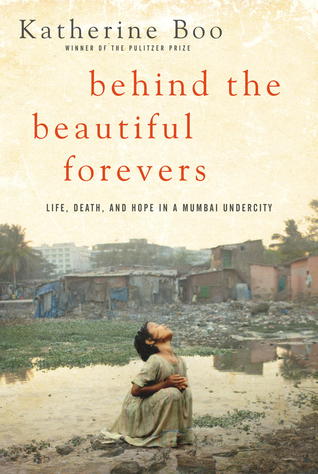
Behind the Beautiful Forevers by Katherine Boo

Title: Behind the Beautiful Forevers: Life, Death, and Hope in a Mumbai Undercity
Author: Katherine Boo

Type: Non-Fiction
Genre: Non-Fiction about India
Series: No
Copyright: 2012
Publisher: Random House

Rating: 4.5 out of 5


Summary: From Good Reads.
From Pulitzer Prize-winner Katherine Boo, a landmark work of narrative nonfiction that tells the dramatic and sometimes heartbreaking story of families striving toward a better life in one of the twenty-first century’s great, unequal cities.

In this brilliantly written, fast-paced book, based on three years of uncompromising reporting, a bewildering age of global change and inequality is made human.

Annawadi is a makeshift settlement in the shadow of luxury hotels near the Mumbai airport, and as India starts to prosper, Annawadians are electric with hope. Abdul, a reflective and enterprising Muslim teenager, sees “a fortune beyond counting“ in the recyclable garbage that richer people throw away. Asha, a woman of formidable wit and deep scars from a childhood in rural poverty, has identified an alternate route to the middle class: political corruption. With a little luck, her sensitive, beautiful daughter—Annawadi’s “most-everything girl“—will soon become its first female college graduate. And even the poorest Annawadians, like Kalu, a fifteen-year-old scrap-metal thief, believe themselves inching closer to the good lives and good times they call “the full enjoy.”

But then Abdul the garbage sorter is falsely accused in a shocking tragedy; terror and a global recession rock the city; and suppressed tensions over religion, caste, sex, power and economic envy turn brutal. As the tenderest individual hopes intersect with the greatest global truths, the true contours of a competitive age are revealed. And so, too, are the imaginations and courage of the people of Annawadi.

With intelligence, humor, and deep insight into what connects human beings to one another in an era of tumultuous change, Behind the Beautiful Forevers carries the reader headlong into one of the twenty-first century’s hidden worlds, and into the lives of people impossible to forget.


Feelings:

I enjoyed reading Behind the Beautiful Forevers. At times it was an uplifting book and others it was devastating.  Katherine Boo does an amazing job bring the lives of those living in Annawadi to life. I did spend time wondering how she knew all that she new but the end of the book gives some insight into her interviews and time spent in Annawadi which explained many of the questions I had about how she could possibly know the things she knew.

The glimpse of normal life in Annawadi might be shocking if we were to see it from a western eye, however, it does not seem abnormal when reading the book. Yes, most of the inhabitants of Annawadi dream of a better life for themselves and their families. The people the book follows can see the prosperity of their country all around them yet they cannot themselves access it.

It interested him that from Airport Road, only the smoke plumes of Annawadi's cooking fires could now be seen. The airport people had erected tall, gleaming aluminum fences on the side of the slum that most drivers passed before turning into the international terminals. Drivers approaching the terminal from the other direction would see only a concrete wall covered with sunshine-yellow advertisements. The ads were for Italianate floor tiles, and the corporate slogan ran the walls the length: BEAUTIFUL FOREVER BEAUTIFUL FOREVER BEAUTIFUL FOREVER. (p. 36-37)
To the scavengers the wall provided a vantage for looking for trash. For them what the rich discarded is their well being.

From 2007 to 2011 Katherine Boo followed the lives of those in Annawadi. During this time we witness hardships and injustice they see in the Indian justice system. The bribes and conflicts that arise because someone will not pay a bribe or they feel as though they are wronged. Corruption is part of life even though many look down on it. Corruption is scary in the forms it takes in this book but it seems this may be something an international community of ad givers may want to address before giving their money.

I would suggest this book to those trying to understand poverty and its pervasiveness in developing countries. This book doesn't offer a solution to slumdweller's poverty but it does have insights mostly provided by the individuals the book follows that might help them reduce their struggling to eat day to day.

Monday, June 24, 2013

I Am Nujood, Age 10 and Divorced by Nujood Ali with Delphine Minoui

Title: I Am Nujood, Age 10 and Divorced
Author: Nujood Ali with Delphine Minoui
Type: Non-Fiction
Genre: Memoir
Series: No
Copyright: 2010
Publisher: Three Rivers Press
Rating: 4.5 out of 5

Summary: from Good Reads

“I’m a simple village girl who has always obeyed the orders of my father and brothers. Since forever, I have learned to say yes to everything. Today I have decided to say no.”

Forced by her father to marry a man three times her age, young Nujood Ali was sent away from her parents and beloved sisters and made to live with her husband and his family in an isolated village in rural Yemen. There she suffered daily from physical and emotional abuse by her mother-in-law and nightly at the rough hands of her spouse. Flouting his oath to wait to have sexual relations with Nujood until she was no longer a child, he took her virginity on their wedding night. She was only ten years old.

Unable to endure the pain and distress any longer, Nujood fled—not for home, but to the courthouse of the capital, paying for a taxi ride with a few precious coins of bread money. When a renowned Yemeni lawyer heard about the young victim, she took on Nujood’s case and fought the archaic system in a country where almost half the girls are married while still under the legal age. Since their unprecedented victory in April 2008, Nujood’s courageous defiance of both Yemeni customs and her own family has attracted a storm of international attention. Her story even incited change in Yemen and other Middle Eastern countries, where underage marriage laws are being increasingly enforced and other child brides have been granted divorces.

Recently honored alongside Hillary Clinton and Condoleezza Rice as one of Glamour magazine’s women of the year, Nujood now tells her full story for the first time. As she guides us from the magical, fragrant streets of the Old City of Sana’a to the cement-block slums and rural villages of this ancient land, her unflinching look at an injustice suffered by all too many girls around the world is at once shocking, inspiring, and utterly unforgettable.


Feelings:
This is the story of a young girl who is brave beyond her years. In Yemen this is not an uncommon fate for young girls from poor families. To be married is an honor and even at a young age one must listen to their family.
One February evening in 2008, when I'd just gotten home, Aba told me he had some good news. "Nujood, you are about to be married." (p. 40)
This is just the start of the suffering that Nujood undergoes at an age where many girls are still in school or enjoying childhood pleasures.
"And why do you want a divorce?" he continues in a more natural tone, as if trying to hide his astonishment. I look him straight in the eye. "Because my husband beats me." ... Point-blank, he asks me an important question: "Are you still a virgin?" ... I'm ashamed of talking about these things. ... But in that same instant I understand that if I want to win, I must take the plunge. "No. I bled." (p. 42)
This is a book full of uncomfortable moments such as this were we wonder if there is something that could be done to have prevented this from happening. Something that could have stopped this child from learning the suffering of life, and loosing her childhood long before she should have. To say that Nujood is brave is an understatement, she had to go against family, tradition, and culture something that would be hard for even a woman of more years and experience.

While the book is simply written the emotions come through strong. For those who are interested in women's rights in third world countries this is a must read. We may feel that we are helpless to do anything for girls half way around the world who are suffering but just being aware of what happens in other countries can change the way we think and the actions we take. And little actions can sometimes make big changes.

Monday, June 17, 2013

Wars, Guns, and Votes by Paul Collier


Title: Wars, Guns, and Votes Democracy in Dangerous Places
Author: Paul Collier
Type: Non-Fiction
Genre: Economic and Political Development
Series: No
Copyright: 2009
Publisher: Harper
Rating: 3.5 out of 5

Summary: from Good Reads. 
Wars, Guns, and Votes, Paul Collier investigates the violence and poverty in the small, remote countries at the lowest level of the world economy. An esteemed economist and a foremost authority on developing countries, Collier argues that the spread of elections and peace settlements in the world's most dangerous countries may lead to a brave new democratic world. In the meantime, though, nasty and long civil wars, military coups, and failing economies are the order of the day--for now and into the foreseeable future.

Through innovative research and astute analysis, Collier gives an eye-opening assessment of the ethnic divisions and insecurites in the developing countries of Africa, Latin America, and Asia, where corruption is often firmly rooted in the body politic. There have been many policy failures by the United States and other developed countries since the end of the Cold War, especially the reliance on preemptive military intervention. But Collier insists that these problems can and will be rectified. He persuasively outlines what must be done to bring peace and stability: the international community must intervene through aid, democracy building, and a very limited amount of force.

Groundbreaking and provocative, Wars, Guns, and Votes is a passionate and convincing argument for the peaceful development of the most volatile places on earth.


Feelings: 

Paul Collier does very interesting research and what he puts forward in this book as well as The Bottom Billion are very good ideas for moving forward and trying to help those that are suck in the bottom in a cycle of poverty and living in a very poor country. 

This book took me a very long time to read for a couple of reasons: 1. His writing style seems to tell a lot about how he went about organizing his research assistants and getting the information he needed which I just don't find all that interesting. If I was the research assistant mentioned I would be honored but it seems to take up space in the book. 2. While he has ideas worth putting into action it is hard to find these ideas as they are often burred in other text.

This book addresses what we as developed countries can do to help those countries in the bottom billion and what countries in the bottom billion can do to help themselves. We have to look at power and how it effects those who have it. Is there anything that can be done to limit power and have checks and balances? What can we in the developed countries to to help the bottom billion countries not have corrupt leadership that drains the budgets?
The fundamental mistake of our approach to state building has been to forget that well-functioning states are built not just on shared interests but on shared identity. Shared identity does not grow out of the soil; it is politically constructed. It is the task of political leadership to forge it. (p.9)
 In the west we need to think about where aid dollars are going and if there is a way we can get them were they are needed without having it free up budget dollars that end up going to the military. How can we help create security in countries of the bottom billion? 
In fact, democracy had the opposite effect in poor countries to that in rich countries. ... We found that in countries that were at least at middle-income levels, democracy systematically reduced the risk of political violence. ... But in low-income countries, democracy made the society more dangerous. ... Democracies get safer as income rises, whereas autocracies get more dangerous. (p.20-21)
To offset the dangerous effects of democracy a country must have a per capita income of about $2,700 a year or $7 a day (p.21). This is a very interesting finding and one that should tell us a great deal about our efforts to use elections as a solve all for problems in the third world. 

This is just a small sample of what is included in the book. It is full of such insights. Without summarizing the entire book and having a very long list of what Paul Collier suggest it is hard to cover everything. My suggestion is slog through the extras and get to the points they are important for the successful development of the bottom billion.

If you could just read the meat of this book and skip the other parts this would be a very good book. I recommend this book to those that have read The Bottom Billion and enjoyed that. In many ways this book carries on the ideas started in there. If you have not read The Bottom Billion I would recommend starting there.